Fixing Electric Trailer Brakes: What You Can DIY and When to Call a Repair Shop Near Batavia, IL
Some electric trailer brake problems take twenty minutes and a multimeter. Others need a shop with the right equipment and experience. Knowing which is which saves you time, money, and a trip back in two weeks with the same issue — here's how to tell the difference.
Intro
If your electric trailer brakes are acting up, the first question most owners ask is whether they can fix it themselves or whether they need a shop. The honest answer is: it depends on what's actually wrong. Some trailer brake problems are straightforward enough that a mechanically capable owner can handle them with the right tools and a bit of patience. Others — especially anything involving the brake drum, the magnet assembly, or the axle wiring on a dump trailer or gooseneck — are better left to a professional who works on these systems every day.
This guide is built for both audiences. If you're working on a utility trailer, cargo trailer, enclosed trailer, gooseneck, or dump trailer with electric brakes, we'll walk you through what the DIY path looks like, where it runs out, and what to expect when you bring it to a repair shop. If you've already diagnosed the problem and know you need professional help, you can head straight to our trailer brake repair page to book a same-week appointment in Batavia.
What Tools You Need Before Fixing Electric Trailer Brakes
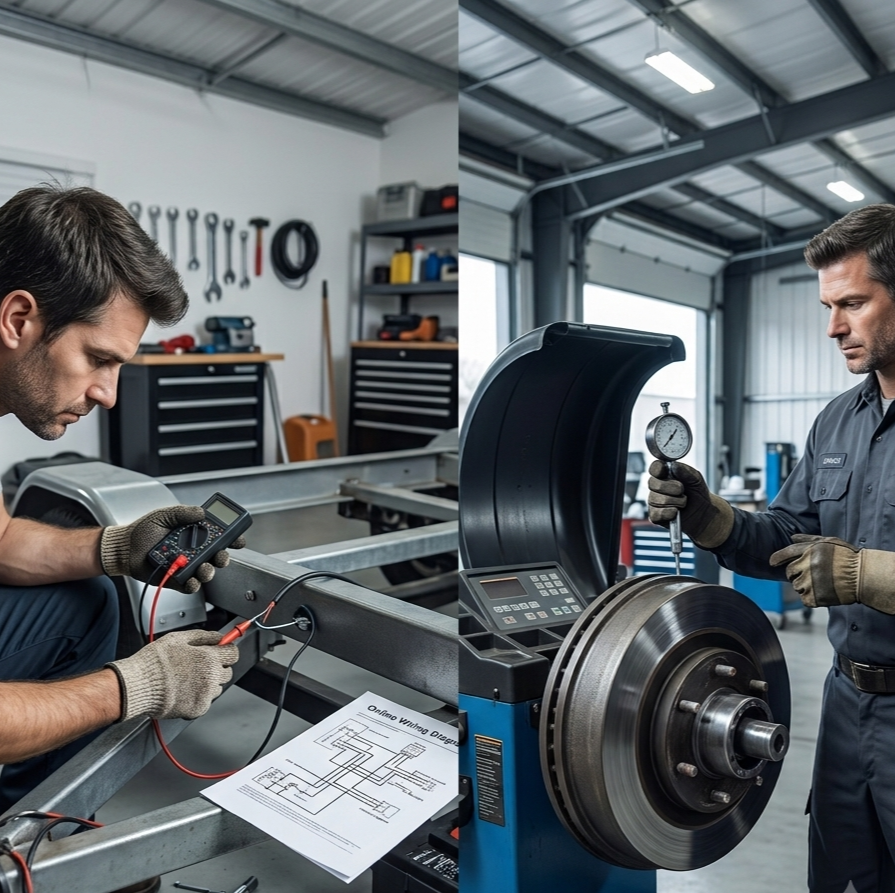
Before you touch anything on the brake system, you need the right tools — otherwise you're guessing, not diagnosing. A digital multimeter is the most important piece of equipment for any electric trailer brake work. It lets you check voltage at the brake output wire, test for ground continuity, and verify whether power is actually reaching your brake magnets. Without it, you're working blind.
Beyond the multimeter, you'll want a 7-pin trailer plug tester to quickly rule out connector issues, which are one of the most common causes of electric trailer brakes not working. Have your brake controller's manual on hand as well — the gain settings and fault code explanations vary by brand, and you'll need to reference them. A basic set of hand tools, wire strippers, electrical tape, and a wiring diagram specific to your trailer round out what you need before starting any trailer brake troubleshooting.
Electric Trailer Brake Repairs You Can Do Yourself
There are several trailer brake issues that fall well within DIY territory, provided you're comfortable working with basic electrical systems. Cleaning corroded pins on the 7-pin trailer plug is one of the easiest fixes and solves more electric trailer brake problems than most people expect. Corrosion at the connector interrupts the signal to the brake controller and can make it look like the entire brake system has failed when the actual problem is a five-minute clean.
Adjusting the gain setting on your brake controller is another DIY-friendly fix. If your trailer brakes are dragging, locking up too aggressively, or barely engaging, the gain is usually the first thing to adjust. Start at 50 percent and test under light load before making further changes. Replacing a blown fuse in the brake circuit is similarly straightforward, as is re-grounding the trailer frame if you've identified a poor ground connection as the source of the issue.
Replacing a brake magnet is on the more involved end of the DIY spectrum, but it's manageable if you've done basic automotive work before. You'll need to pull the wheel, remove the drum, and swap the magnet — a job that takes about an hour per axle on most trailers. If you're comfortable with that level of work and have confirmed with your multimeter that the magnet is the problem, it's a reasonable repair to take on yourself.
Electric Trailer Brake Repairs That Need a Professional
Once you get past the electrical diagnostics and connector-level fixes, the repairs get significantly more involved. Brake drum resurfacing or replacement is not a DIY job on most trailers — it requires the drum to be measured for runout and wear, and either machined or replaced depending on the readings. A worn or warped drum causes the brakes to pulse, grab unevenly, or fail to hold under load, and no amount of magnet cleaning or gain adjustment will fix it.
Axle wiring harness repairs are another area where professional help pays off. On multi-axle gooseneck trailers and dump trailers, the wiring runs through tight channels along the frame and axles, and tracking down a short circuit or a chafed wire in that harness takes experience and the right test equipment. A full magnet and shoe assembly replacement — where the entire brake assembly on an axle needs to come apart — is also work best done by a shop that handles it regularly and has the correct torque specs for your trailer's hub configuration.
Hydraulic-electric hybrid actuator systems found on some dump trailers add another layer of complexity. These systems use a hydraulic actuator triggered by the electric brake controller, and diagnosing failures in those systems requires knowledge of both the hydraulic and electrical sides. If your dump trailer brakes are failing and you've ruled out the basic electrical causes, bring it to a specialist. Our trailer repair team in Batavia handles all of these repairs on dump trailers, gooseneck trailers, enclosed trailers, and utility trailers throughout Kane and DuPage County.
How Much Does Fixing Electric Trailer Brakes Cost?
The cost of fixing electric trailer brakes depends almost entirely on what's wrong. On the DIY end, a brake magnet runs roughly $15 to $40 per wheel, a 7-pin plug replacement is under $20, and a new fuse or ground wire is nearly nothing. If you can correctly diagnose the problem and the repair is within your skill level, you can get electric trailer brakes back in working order for under $100 in parts.
Professional repair costs vary more widely. A brake magnet replacement at a shop — where labor, inspection, and proper torque specs are included — typically runs $80 to $200 per axle depending on trailer type and access. Brake drum resurfacing adds to that if the drum has worn beyond spec. A full brake assembly replacement on a multi-axle gooseneck or dump trailer is a larger job and will be priced accordingly. The best way to get an accurate number for your specific trailer is to request a free estimate — our Batavia shop provides written estimates before any work begins, with no surprises at pickup. Contact us here to get a free brake repair estimate.
Fixing Electric Trailer Brakes in Batavia, Geneva & St. Charles — What to Expect at Our Shop
When you bring a trailer to Ramirez Truck & Trailer Repair for electric brake service, the process starts with a full brake inspection — not just the component you think is the problem, but the entire system. Brake issues often have more than one cause, and we'd rather find the second problem now than have you come back in two weeks. We'll check the magnets, drums, wiring, ground connections, controller output, and plug connection before recommending any repairs.
Turnaround time for most electric trailer brake repairs is same-day or next-day. Larger jobs on multi-axle trailers may take a day longer depending on parts availability, but we'll give you a realistic timeline upfront. We work on all non-commercial trailer types — utility trailers, cargo trailers, enclosed trailers, gooseneck trailers, and dump trailers — and we serve customers from Batavia, Geneva, St. Charles, Aurora, Elgin, Naperville, and the surrounding Fox Valley area. If you've been troubleshooting trailer brake issues and want a second set of eyes on it, we're a straightforward shop that gives you honest answers. You can also read our full trailer brake troubleshooting guide if you want to keep working through the diagnosis yourself first.
FAQs — Fixing Electric Trailer Brakes
The most reliable way to test a brake magnet is with a multimeter. A functioning magnet on a standard 10-inch or 12-inch electric brake should read between 3.0 and 4.0 ohms of resistance. A reading significantly outside that range — or an open circuit reading — means the magnet has failed and needs to be replaced. You can also check by applying power directly to the magnet leads and feeling for a strong magnetic pull. A weak pull or no pull at all confirms the magnet is worn out. If you're not comfortable testing this yourself, our Batavia shop can diagnose it quickly as part of a full brake inspection.
Yes, with the right tools and some mechanical experience. You'll need to remove the wheel and brake drum to access the magnet, which is held in place by a retaining arm and a few bolts. The process is straightforward on most trailers, but access can be tight on low-slung enclosed trailers or trailers with fender skirts. The more important factor is confirming the magnet is actually the problem before replacing it — a new magnet won't fix a bad ground connection or a failed brake controller. Use a multimeter to verify the diagnosis first, then replace only what's actually failed.
For most common repairs — magnet replacement, wiring repair, drum inspection, and controller testing — expect same-day or next-day turnaround at our Batavia shop. We offer same-week appointments for customers throughout the Fox Valley, and we give you a clear timeline before work begins. More involved jobs on multi-axle trailers or trailers requiring drum replacement may take an additional day depending on parts, but we'll let you know upfront.
Yes. Illinois DOT inspections include brake system checks, and electric brakes that are non-functional, dragging, or failing to meet stopping performance standards are a violation. For commercial operators, this can mean an out-of-service order until repairs are completed. Even for non-commercial trailers, operating with failed brakes creates serious liability — particularly on gooseneck and dump trailers that carry significant weight. If your trailer is due for inspection or you have reason to believe the brakes aren't performing correctly, it's worth having them checked before you're on the road. Schedule a brake inspection in Batavia by visiting our contact us page..
Ready to Get Your Trailer Brakes Fixed?
If your electric trailer brakes need more than a quick DIY fix, Ramirez Truck & Trailer Repair in Batavia has you covered. We service dump trailers, utility trailers, gooseneck trailers, cargo trailers, and enclosed trailers throughout Kane and DuPage County — including Geneva, St. Charles, Aurora, Elgin, Naperville, and beyond. Written estimates before every job. Honest pricing. Same-week appointments available. Call us at (224) 595-0168