Trailer Light Repair Near Batavia, IL — What Every Trailer Owner Should Know
A failed brake light got you a roadside ticket. A dead running light failed your DOT inspection. Or worse — a night haul where your trailer went dark and you didn't know it. Trailer lighting problems aren't just inconvenient — they're dangerous and illegal. Here's everything Batavia-area trailer owners need to know.
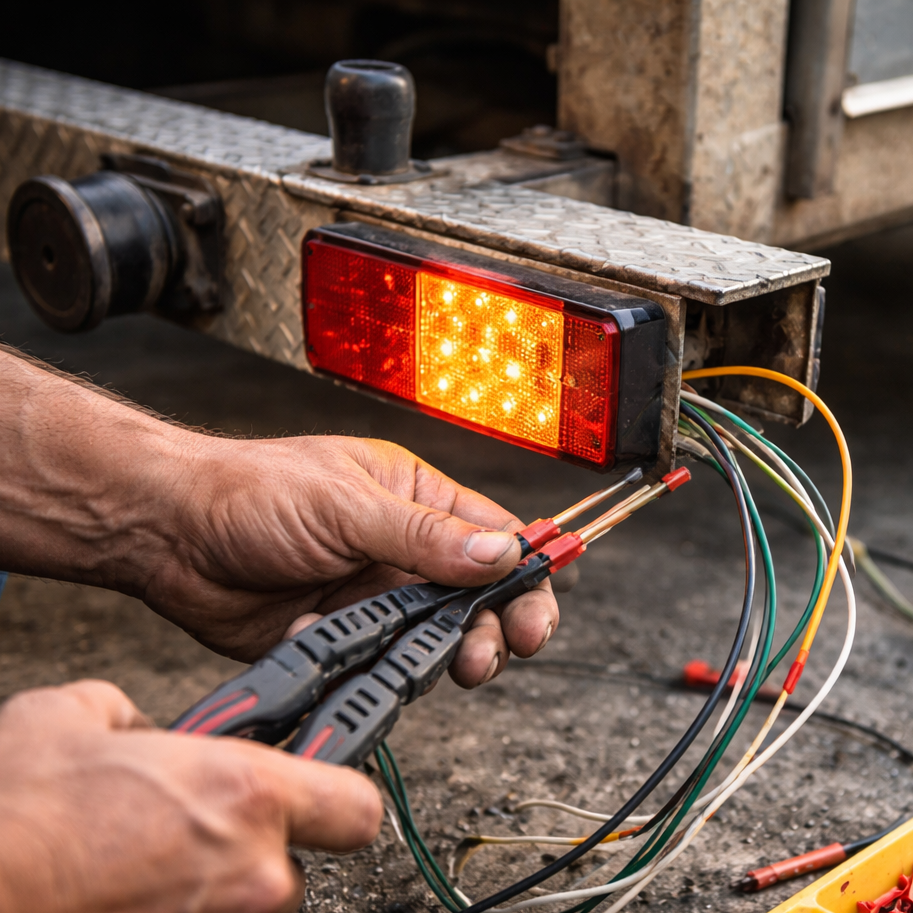
Why Trailer Light Repair Matters — And What Illinois Law Requires
Trailer lighting isn't just a courtesy feature — it's a legal requirement. In Illinois, all trailers operated on public roads must have functioning brake lights, turn signals, and rear running lights. Trailers over a certain width are also required to have clearance lights and side markers. Failing to maintain these isn't just a fix-it ticket — it can result in a failed roadside inspection, a citation, or liability in the event of an accident where another driver couldn't see your trailer.
Illinois Law — What's Required
- Brake lights: Required on all trailers. Must activate when the tow vehicle brakes.
- Turn signals: Required and must be synchronized with the tow vehicle.
- Rear running lights: Required whenever the vehicle is operated at night or in low visibility.
- Clearance & side marker lights: Required on trailers 80 inches or wider.
- Reflectors: Required on all trailers regardless of size.
Beyond the legal side, functioning trailer lights are your primary communication to drivers behind you. A dump trailer with no brake lights on a busy Fox Valley road is a serious safety hazard — for you, your load, and everyone around you.
Need a repair, not a reading lesson? Skip ahead and check out all our trailer repair services in Batavia, IL — we'll get you scheduled fast. You can also go straight to our trailer lighting and electrical repair page.
5 Signs Your Trailer Needs Light Repair
Trailer light problems don't always announce themselves all at once. Some show up gradually — a flicker here, a dead zone there — before they fail completely. Here are the five most common warning signs to watch for. If you notice any of them, run the trailer light troubleshooting steps below before you head to the shop.
01 Flickering Lights
Lights that flicker or flash randomly usually point to a loose connection, a corroded ground wire, or a failing 7-pin plug. Don't ignore a flicker — it will become a full outage.
02 Dead Zones
One side working, the other not — or rear lights on but no brake signal. Dead zones often mean a broken wire, a blown fuse, or a failed bulb socket on that circuit.
03 Corroded Connectors
Green or white buildup on the 7-pin plug is a red flag. Corrosion increases resistance and causes intermittent failures that are hard to diagnose without cleaning the connection first.
04 Burn Smell or Melted Plastic
A burning smell near the trailer plug or a melted light housing means a short circuit. This needs immediate attention — electrical shorts can damage your tow vehicle's wiring too.
05 Brake Light Stuck On
Brake lights that stay lit when you're not braking usually indicate a wiring short or a brake controller issue. Ongoing drain on your electrical system and a safety hazard for drivers behind you. If your trailer brakes act up at the same time, read our trailer brake troubleshooting guide.
Common Causes of Trailer Wiring Problems
Most trailer light failures trace back to one of a handful of root causes. Understanding what causes the problem helps you describe it accurately when you call — and helps us fix it faster.
Corrosion from Road Salt and Moisture
Illinois winters are hard on trailer wiring. Road salt accelerates corrosion on exposed connectors, light housings, and bare wire ends — especially on trailers that sit outside year-round. Corrosion is the #1 cause of intermittent trailer lighting failures.
Faulty or Worn 7-Pin Connector
The 7-pin plug takes a beating — dragged on the ground, stepped on, filled with debris. Bent pins, cracked housings, and corroded contacts are all common failure points. A bad plug can make the whole trailer lighting system appear dead even when the wiring itself is fine.
Grounding Issues
Trailer lighting runs on a shared ground circuit. A single bad ground — a loose bolt, a rusted frame contact, a corroded ground wire end — can cause flickering, dim lights, or a complete failure across multiple light zones. Grounding faults are notoriously tricky to track down without the right testing equipment.
Road Debris Damage
Trailer wiring runs along the frame, often unprotected. Rocks, branches, and road grime can chafe through wire insulation, crack conduit, and damage light housings — especially on dump trailers and gooseneck trailers that operate on job sites and unpaved roads.
Failed Bulbs or LED Strips
Standard incandescent bulbs burn out over time. LED lights last longer but can fail at the strip level, leaving dark zones in the light bar. On older trailers, moisture intrusion into the housing is the more common cause of LED failure.
Trailer Light Troubleshooting: 7 Checks You Can Do Before You Call
Trailer lights not working? Most problems can be narrowed down in about 15 minutes with a few basic tools. This trailer light troubleshooting checklist works for dump, utility, cargo, enclosed, and gooseneck trailers. Start at the tow vehicle and work back toward the trailer's tail lights.
What you'll need: a flashlight, a 12-volt test light or multimeter, a small wire brush or contact cleaner, dielectric grease, and a helper to press the brake pedal.
Step 1: Test the Lights With a Helper
Hook up the trailer and have someone stand behind it while you run the running lights, left and right turn signals, and brake pedal. Write down exactly which lights fail. A pattern — for example, "left signal only" or "everything dead" — tells you where to look first.
Step 2: Inspect the Plug and Socket
Look inside the 7-pin plug on the trailer and the socket on the tow vehicle. Check for bent pins, cracked housings, green or white corrosion, and packed-in dirt. Clean the contacts with a wire brush or contact cleaner, then add a thin layer of dielectric grease.
Step 3: Check the Tow Vehicle Fuses
If nothing on the trailer works, check the fuse for the trailer lighting circuit in the tow vehicle's fuse box. A blown fuse can look like a trailer problem when the trailer is fine. If it blows again right away, you likely have a short, so stop and call a shop.
Step 4: Test for Power at the Plug
Use a test light or multimeter at the tow vehicle socket. Each pin should show 12 volts when its function is on: running lights, left turn, right turn, and brake. No power at the socket points to the tow vehicle's wiring or a fuse. Power at the socket but no light on the trailer points to the trailer.
Step 5: Check the Ground
A bad ground causes dim, flickering, or "backwards" lights, such as a turn signal that also flashes the opposite side. Find the trailer's white ground wire where it bolts to the frame. Remove it, sand the contact point to bare metal, and re-tighten it. Also check that the tow vehicle's socket ground is clean.
Step 6: Inspect the Bulbs and Light Housings
Pull the lens and look at each bulb socket. Look for cloudy or burnt bulbs, green corrosion on the socket, and water inside the housing. If the trailer uses LED lights, check the light bar for dark segments and the housing for cracks.
Step 7: Trace the Wiring Along the Frame
Follow the harness from the tongue to the tail lights. Look for rubbed-through insulation, pinched wires, loose connectors, and spots where wires hang close to axles or tires. A single broken wire can take out a whole light circuit.
When Troubleshooting Isn't Enough
If you've worked through all seven checks and the lights still fail, stop guessing. Repeated fuse failures, burning smells, melted plugs, and intermittent faults all need proper testing. Our technicians use tracing and load-testing tools that find shorts and hidden grounding faults quickly, which saves you from replacing parts that were never broken. For a full electrical diagnosis, see our trailer light repair services in Batavia, IL, or call (224) 595-0168.
Safety note: Disconnect the trailer from the tow vehicle before cutting, splicing, or replacing any wiring. Never work on a trailer with the plug connected to a running vehicle.
How Much Does Trailer Light Repair Cost Near Batavia, IL?
This is the question everyone wants answered before they call. The honest answer: it depends on what's wrong.
Want to know exactly what your trailer repair will cost? See our full list of trailer repairs we handle — or call for a free estimate.
How We Fix Trailer Lights at Ramirez Truck and Trailer Repair Services in Batavia
We don't just replace the bulb and hope for the best. Our process starts with a proper diagnosis — because fixing the symptom without finding the root cause means the problem comes back. It's trailer light troubleshooting done with professional tools. Here's what to expect when you bring your trailer to our Batavia shop.
1. Full Electrical Inspection
We test the 7-pin connection, check for power at each light circuit, and verify ground continuity across the trailer frame. This tells us whether the issue is in the plug, the harness, or a specific light.
2. Root Cause Diagnosis
We trace the fault to its source — not just the light that's out, but why it's out. Corrosion, shorts, broken wires, and grounding faults all look similar from the outside but require different fixes.
3. Written Estimate Before We Touch It
Once we know what's wrong, we give you a clear written quote. You approve the work before we start. No hidden charges, no "while we were in there" surprises.
4. Repair — Quality Parts, Weatherproofed
We use weatherproof connectors, marine-grade heat shrink, and quality LED replacement lights. Illinois winters are brutal on trailer wiring — we fix it to last, not just to pass a quick check.
5. Full Light Test Before You Leave
We test every circuit — brake lights, turn signals, running lights, markers — before the trailer leaves our Batavia shop. You leave knowing everything works.
Most trailer light repairs are completed same-day. We serve customers from Batavia, Geneva, St. Charles, North Aurora, Aurora, Elgin, and throughout the Fox Valley.
Keep your trailer road-ready all year with our trailer preventative maintenance service, which includes a lighting and wiring check.
FAQs About Trailer Light Repair Near Me
Start with the plug and socket, then check the tow vehicle fuse, test for power at the plug, clean the ground connection, and inspect the bulbs and wiring along the frame. If the lights still fail, a shop can trace shorts and hidden ground faults.
The most common causes are a corroded 7-pin plug, a bad ground, a blown fuse in the tow vehicle, or a broken wire along the frame.
A constantly lit brake light usually points to a wiring short or a brake controller or switch problem. Have it checked, since it can drain your battery and confuse drivers behind you.
It depends on the problem. A bulb or plug is a small repair, while tracing a short or replacing damaged wiring takes more time. We give a written estimate before work starts.
Need Trailer Light Repair in Batavia, IL?
Don't tow with broken lights. Call Ramirez Truck and Trailer Repair Services at (224) 595-0168 or request a free estimate. We'll diagnose the problem, give you a written quote, and get you back on the road.